


This is a story about breaking the rules of “best practices” on Facebook and being rewarded for it. If you’re frustrated with social media these days, this post is for you.
First, a set up to the post. Then the marketing insights!
A Canadian Camino
Earlier in September I ventured on a week-long hiking trip with my daughter on Vancouver Island. Together we walked 120km on the Trans Canada Trail from Nanaimo to Victoria. The route, normally a 90 minute straight shot by car down the highway, became a whole new journey, weaving through communities, farmland, fresh water lakes, ocean vistas and a final climb over the Malahat pass. We billed it our Canadian Camino, with a mix of camping and a farm stay along the way, capped off with a luxury night and spa in Victoria at the end, and attending Christ Church Cathedral Sunday morning.
I wrote an article for Trans Canada Trail about the experience, which is now live on their site: Mary’s Trans Canada Trail: A Canadian Camino https://tctrail.ca/stories/marys-trans-canada-trail-a-canadian-camino/
Of course, I posted and shared the article on social media, and that’s where the marketing insights begin!
The Facebook post
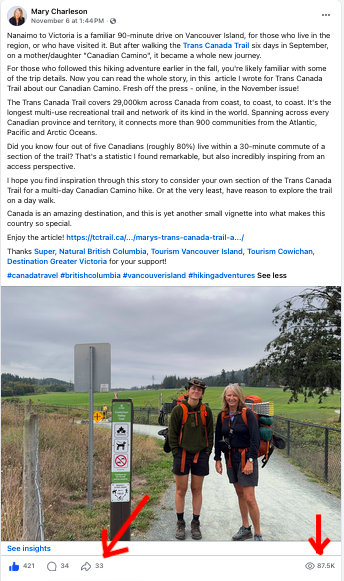
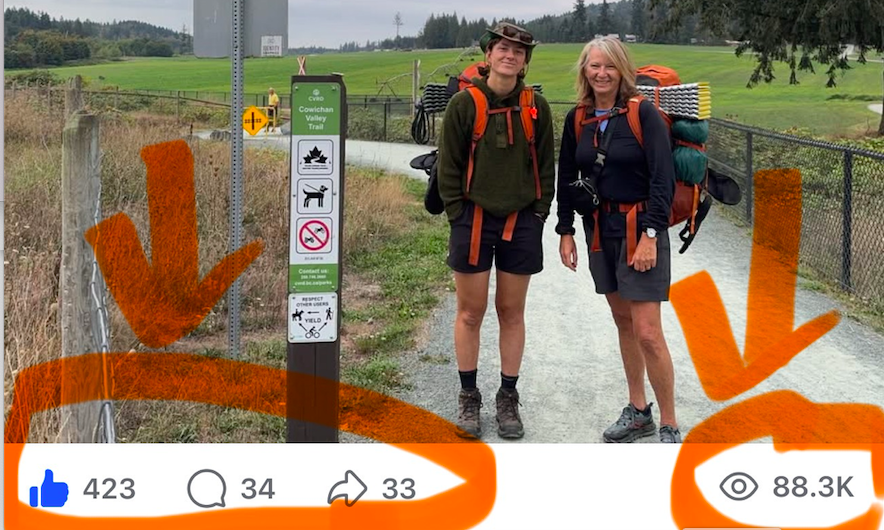
I’ve been blown away at the response to sharing the article on Facebook. I’m not sure if the Meta algorithm made a mistake, but my post is currently sitting at over 88K views on Facebook, with 421 reactions, 34 comments and 33 shares. Trust me, I don’t have that many friends! (This image show the metrics, for a copy of the entire post, scroll to the end of this article)
Breaking the rules
What’s really curious though is the post broke all the traditional rules we’re told that lead to traction:
- This post had a single image. There was no video. There was no vertical “reel” version of the post, which we are told is favoured by the algorithm
- The post, while telling a story on its own, lead primarily to an outside link. The goal was to get people to read an article not hosted on Facebook. Usually posts with outside links are penalized. Meta wants the eyeballs to stay in their ecosystem so they can serve up ads in the feed.
- The post was shared on a Friday afternoon – certainly not one of the recommended times to post on the platform. Add the fact that it was posted Friday afternoon Pacific time, it might as well have hit Friday night for most of US and Canada audiences. Hardly ideal.
- The post was shared to a public audience, rather than just friends. That’s potentially good for reach, but it could also bomb, since friends and family generally care more about personal content.
- The post was not cross posted on Instagram, which we’re told can increase reach.
- The post used #hashtags to channel content, but Meta has also said these increasingly matter less
Basically in a world of video first, that favours reels, and sound bites over storytelling, to keep people in the feed, this post got traction. Which begs the question – why?
Why did it work?
I have some theories:
- The 33 shares happened quickly, which pumped up the exposure exponentially.
- Being shared so widely also indicated to the algorithm that the content was desirable, so the algorithm no doubt opened it up to more readers.
- The shares went into feeds and DMs, and were coming from people who were known and trusted, and going to people pre-qualified to care. Both of those points are key. So the content got read, and in many cases, shared yet again
- There was early and deep engagement. Not from bots, but real people. Comments were thoughtful and detailed. Readers sharing their own experience on the trail. They asked questions. They posted their own photos in comments. (The guy with the photo from kilometer zero in Tuktoyaktuk takes the prize). I’ll pause here while you Google map Tuktoyaktuk!
- Readers tagged friends in comments, which triggered additional people to read the content
- I tagged tourism organizations who had helped in organizing the trip. Some of those teams shared the content – but most of that didn’t happen until the following Monday or Tuesday when they were back at work. See the thoughts on Friday not being ideal noted earlier.
- I replied to every single comment and DM message. The replies were personal, helpful, offered additional information in response to questions, and were undoubtedly generated by a human, not a bot. Thankfully I clued into the post taking off on Saturday. Responses from the post creator signals engagement to the algorithm
A breath of fresh air
Could this result be replicated using some of the observations made here? Possibly. But what I really think was at the heart of it was how the content stood out from all the other – frankly crap, which is cluttering our feeds. Divisive content, sensationalized messages, AI generated fake images, endless ads. The content was a breath of fresh air.
- It was authentic, human and real, created by someone you might actually like to hang out with
- There was an obvious mother/daughter connection, we were relatable
- The story was aspirational – the benefits of exercise, getting outdoors, spending time with family
- There was a “Canada pride” undercurrent to the content, which if you’re Canadian, you’ll understand is on fire right now. And if you’re American, you’ll likely understand why.
- Nobody was selling anything
Metrics backed up by site visits
Less you consider these metrics an isolated Meta thing, Trans Canada Trail, reached out by email unsolicited to note their shock at how the story had bumped site visits on their end. With 10x the views normally reached for their articles, and an average time on page over 2 minutes, it was a clear indication that something unusual was driving the traffic. The viral Facebook post no doubt helped, and the LinkedIn share wasn’t too shabby either. But it was the content that had driven the interest.
I think this example offers a ray of hope to those who are tired of doing what everyone else is doing, following best practices, and getting poor results.
Is it possible that just being relatable, writing original copy yourself, using your own imperfect photos, and sharing stuff that people care about is enough to go viral? Somewhere out there, people are craving honest, thoughtful engagement. Meta might not be telling you this is what works. But real people are.
The original Facebook post
For those curious about the copy which accompanied the Facebook post which drove all views, reactions, comments and shares, here you go!